
Table of Contents
Introduction of Cooling Fins:
- Fins are the extended surfaces designed to Increase heat transfer rate for a fixed surface temperature, or lower surface temperature for a fixed heat transfer rate.
- Heat transfer by convection between a surface and the fluid surrounding can be increased by attaching to the surface called fins.
- 通过固体导热,墙壁,或准备daries has to be continuously dissipated to the surroundings or environment to maintain the system in a steady-state condition. In many engineering applications large quantities of heat needed to be dissipated from small areas.
- The fins increase the effective area of a surface thereby increasing the heat transfer by convection. Rectangular fin and triangular fins are straight fins. Triangular fins are attractive, since for an equal heat transfer it requires much less volume than rectangular fins. Hence the fins have practical importance because it gives maximum heat flow per unit mass with ease of manufacture.
Types of Fins:
Fins can be broadly classified as:
1. Longitudinal fin
2. Radial fin
3. Pin fin
(a) Longitudinal fin – Rectangular profile
(b) Longitudinal fin – Rectangular profile
(c) Longitudinal fin – Trapezoidal profile
(d) Longitudinal fin – Concave parabolic

(e) Radial fin – Rectangular profile
(f) Radial fin – Triangular profile

(g) Pin fin – Cylindrical
(h) Pin fin – Tapered profile
(i)PIN FIN - 凹形抛物线

Other types of Fins are :
- Constant area straight fin
- Variable area straight fin
- 引脚鳍
- Annular Fin
-
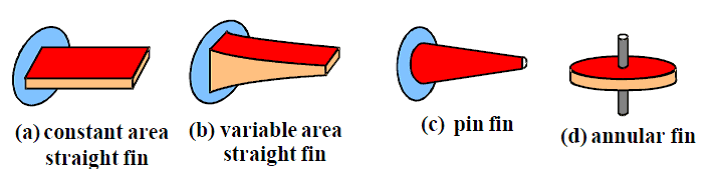

- 鳍的类型
Materials of fins
- 最常见的散热器材料是铝合金,具有229 W/MK的较高导热率值之一,但在机械上柔软。
- Copper has around twice the thermal conductivity of aluminum and faster, more efficient heat absorption. But it is more expensive than aluminum
Heat Transfer From Extended Surface
-
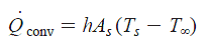

- Equation of fins
As is the heat transfer surface area and where.
- To increase the convection heat transfer coefficient ( h) –Increasing h may require the installation of a pump or fan, or replacing the existing one with a larger one, but this approach may or may not be practical. Besides, it may not be adequate.
- To increase the surface area ( As) –The alternative is to increase the surface area by attaching to the surface extended surfaces called fins made of highly conductive materials such as aluminum. Finned surfaces are manufactured by extruding, welding, or wrapping a thin metal sheet on a surface. Fins enhance heat transfer from a surface by exposing a larger surface area to convection and radiation.
-
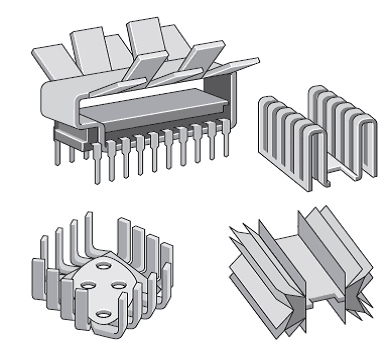

- Innovation In Fins
- In the analysis of fins, we consider steady operation with no heat generation in the fin, and we assume the thermal conductivity k of the material to remain constant.
- We also assume the convection heat transfer coefficient h to be constant and uniform over the entire surface of the fin for convenience in the analysis.
- We recognize that the convection heat transfer coefficient h, in general, varies along the fin as well as its circumference, and its value at a point is a strong function of the fluid motion at that point.
- 鳍基底的H值通常比鳍尖低得多,因为流体被基部附近的实心表面包围,这严重破坏了其运动至“suffocating”it, while the fluid near the fin tip has little contact with a solid surface and thus encounters little resistance to flow.
- Therefore,adding too many fins on a surface may actually decrease the overall heat transfer when the decrease in h offsets any gain resulting from the increase in the surface area.
Fin efficiency
Fin efficiency is the ratio of heat transfer from the actual fin to the heat transfer of an imaginary fin of the same geometry and same conditions but with an infinite conductivity (In other words, if the entire fin surface was in a temperature equal to that of the fin base).
这个比率总是小于一个

Fin effectiveness
Fin effectiveness is the ratio of heat transfer from the fin to the heat transfer if the fin wasn’t existing. In换句话说,这个数量告诉我们鳍正在转移多少额外的热量。

The desire is to have this ration as large as possible while keeping the additional cost of adding the fins as low as possible.
Fins are not provided on the inner surface of the cylinder :
The reasons are,
通过对流传热通过鳍片传热。对流传热可以表示为以下乘积,
- 传热系数(HTC)of fluid to which they are exposed,
- Surface Area of the fin(s),
- The temperature differencebetween the fin(s) and the fluid to which they are exposed.
Effectiveness and efficiency depend on the medium in which fins are being used.
Now, efficiency for internal combustion engines of on-road vehicles is less than 40%. Which means 60% of energy is being dissipated to the surrounding. So, there is a need of fins on the outer surface of the cylinder as you have to transfer heat energy from the engine to the surrounding (else the engine will wear out quickly). What would be the use of fins inside the cylinders? They simply won’t help to cool down the engine as
- There is no increase in the surface area from which heat will be transferred to the surrounding.
- HTC of the fluid inside the cylinder is higher than the HTC of fluid on the outer surface of the cylinder.
It is okay to apply fins on both surfaces of pipes or tubes when HTC of fluid on the inner and the outer surface is comparable in magnitude.
鳍的优势:
- By using the fins, the heat transfer rate can be increased without any preventive maintenance. It is the cheapest way for increasing the heat transferring rate from the hot bodies.
Disadvantages Of Fins :
We know that the length of the fins is directly proportional to the heat-transferring rate. But the larger length is may be cause of bending in the fins and also increases the weight of the engine. Therefore the overall efficiency will go to decrease.
Application Of Fins :
Example of surfaces where fins are used
1. Air-cooled I.C. engines
2. Refrigeration condenser tubes
3. Electric transformers
4. Reciprocating air compressors
5. Semiconductor devices
6. Automobile radiator
7. Cooling Of Electronic components
8. Dry-type cooling towers
9. They are also used in newer technology such as hydrogen fuel cells.
Heat Transfer Notes , Article , Interview Que. and Ans.
Mechanical Subjectwise Basic Concept Notes ,Articles
Related posts:
 Heat Transfer Analysis of Engine Cylinder Fins Having Triangular Shape
 Engine Cooling | Air Cooling System – Advantages and Disadvantages
 Heat Exchanger – Types, Diagram, Working, Applications , Advantages
 Cooling System | Types , Advantages and Disadvantages
 Types Of Heat Exchanger | Basic Of Heat Transfer
 Water Cooling – Parts, Working, diagram, Advantages and Disadvantages
 What is a Cooling Tower | Types of Cooling Towers
 Water Cooling System in Engine | types of water cooling system