目录
什么是应变仪 - 应变仪表
什么是应变仪?
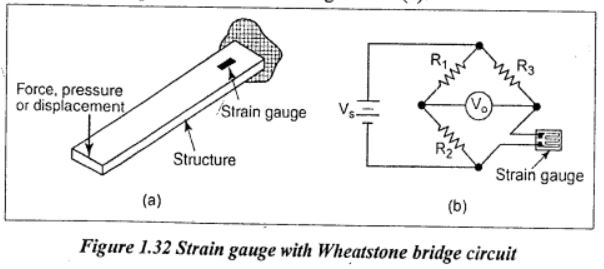
最广泛使用的压力和力敏感换能器是应变仪。应变仪的原理基于电导体的电阻性。
Electrical conductor possesses resistance based on the relationship
r =ρ(l / a)
其中R是电阻,ρ是电阻率,L是长度,a是横截面的区域。
When a metal conductor is stretched or compressed, its resistance changes because of the fact that both length and diameter of the conductor change. These effects, called压阻效应,可用于测量若干变量,如应变和实验应力分析中的统治应力,尺寸变化小。

在图的顶部,导体无关。在该图的底部,导体处于张力,增加其长度并减小其区域。应变仪的抗性与其尺寸变化成比例地变化。

仪表因子,G, of a strain gauge is the ratio of relative change in resistance to the relative change in length.

制作应变仪中的两个主要结构:保税和不合理。这些如图所示。在未粘合的应变计中,导线电阻元件在两个柔性支撑件之间拉伸。电线根据施加到隔膜的力伸展。由于这些力,导线的电阻变化。

In a bonded strain gauge, a wire metal foil is placed in a thin metal diaphragm. When the diaphragm is flexed, the element deforms and change in resistance occurs. Generally, bonded strain gauge is more durable than unbonded.
有三种类型的应变仪:
(一种)金属电阻应变仪由金属电线制成,例如恒定(Cu-Ni合金)镍铬物V或铂合金。
(b)铝箔应变仪由薄,8-15μm硝基纤维素浸渍浸渍纸,其上附着光蚀刻金属合金长丝作为电阻材料。对于更高的温度,使用环氧树脂衬底代替纸张。
测量幅的主动长度沿横轴。表格应以横轴安装在与力或菌株的应用方向相同的方向上。因此,测量仪的伸长率降低了长度,从而降低了电阻。
(c)第三种类型是半导体计。这取决于硅和锗的压阻性。它们具有高灵敏度,具有50到200的规格因子。它们的主要缺陷是由于温度和非线性输出引起的波动。p型仪表增加电阻采用施加的拉伸应变,而N型计电阻降低。测量仪通常通过环氧粘合剂或陶瓷水泥粘合到该结构上。