
Table of Contents
Two Stroke Engine : Parts , Cycle , Diagram , Working , Application
A two-stroke (or two-cycle) engine is a type of internal combustion engine which completes a power cycle with two strokes (up and down movements) of the piston during only one crankshaft revolution. This is in contrast to a “four-stroke engine”, which requires four strokes of the piston to complete a power cycle during two crankshaft revolutions. In a two-stroke engine, the end of the combustion stroke and the beginning of the compression stroke happen simultaneously, with the intake and exhaust (or scavenging) functions occurring at the same time.
Two-stroke engines often have a high power-to-weight ratio, power being available in a narrow range of rotational speeds called the “power band”. Compared to four-stroke engines, two-stroke engines have a greatly reduced number of moving parts, and so can be more compact and significantly lighter.
两个STROK部分E ENGINE
1. Piston
In an engine, the piston is used to transfer the expanding force of gases to mechanical rotation of crankshaft via a connecting rod. The piston is able to do this because it is secured tightly within the cylinder using piston rings to minimize the clearance between cylinder and piston.
2. Crankshaft
A crankshaft is a part which is able to convert the reciprocating motion to rotational motion.
3. Connecting rod
A connecting rod transfers motion from a piston to crankshaft which acts as a lever arm.
4. Counterweight
The counterweight on the crankshaft is used to reduce the vibrations due to imbalances in the rotating assembly.
5. Flywheel
The flywheel is a rotating mechanical device which is used to store energy.
6. Inlet & Outlet Ports
It allows to enter fresh air with fuel & to exit the spent air-fuel mixture from the cylinder.
7. Spark Plug
A spark plug delivers electric current to the combustion chamber which ignites the air-fuel mixture leading to an abrupt expansion of gas.

CYCLES OF TWO STROKE ENGINE
1. Intake
The fuel/air mixture is first drawn into the crankcase by the vacuum that is created during the upward stroke of the piston. The illustrated engine features a poppet intake valve; however, many engines use a rotary value incorporated into the crankshaft.
2. Crankcase compression
During the downward stroke, the poppet valve is forced closed by the increased crankcase pressure. The fuel mixture is then compressed in the crankcase during the remainder of the stroke.
3. Transfer/Exhaust
Toward the end of the stroke, the piston exposes the intake port, allowing the compressed fuel/air mixture in the crankcase to escape around the piston into the main cylinder. This expels the exhaust gasses out the exhaust port, usually located on the opposite side of the cylinder. Unfortunately, some of the fresh fuel mixtures is usually expelled as well.
4. Compression
The piston then rises, driven by flywheel momentum, and compresses the fuel mixture. (At the same time, another intake stroke is happening beneath the piston).
5. Power
At the top of the stroke, the spark plug ignites the fuel mixture. The burning fuel expands, driving the piston downward, to complete the cycle. (At the same time, another crankcase compression stroke is happening beneath the piston.)
WORKING OF 2 STROKE ENGINES
Down Stroke
First, the piston is moved downside from TDC to BDC to let the fresh air enter into the combustion chamber. The fresh air-fuel mixture gets into the combustion chamber through the crankcase. Crankshaft rotation – 180°
Up Stroke
这里发生了所有的魔力。从BDC向TDC推高活塞。燃料 - 空气混合物被压缩和火花塞点燃混合物。当混合物扩张时,活塞向下移动。在上行程期间,打开入口。在打开此入口处,混合物被吸入曲轴箱内。当混合物在先前的上行期间将混合物推入燃烧室时,产生部分真空,因为在曲轴箱中没有留下混合物。该混合物可以在下游进入燃烧室,但在曲轴箱中保留在曲轴箱中,直到活塞上升到TDC。曲轴旋转 - 360°
Two strokes get completed along with one power cycle.
From the 2nd downstroke onwards the exhaust gases get expelled out from one side while a fresh mixture enters into the combustion chamber simultaneously due to the partial vacuum created in the combustion chamber after removal of exhaust gases. This is the beauty of the engine. Both things happen at the same time which makes it a 2 stroke engine.
Two-stroke diesel cycle goes like this:
1. When the piston is at the top of its travel, the cylinder contains a charge of highly compressed air. Diesel fuel is sprayed into the cylinder by the injector and immediately ignites because of the heat and pressure inside the cylinder.
2. The pressure created by the combustion of the fuel drives the piston downward. This is the power stroke.
3. As the piston nears the bottom of its stroke, all of the exhaust valves open. Exhaust gases rush out of the cylinder, relieving the pressure.
4. As the piston bottoms out, it uncovers the air intake ports. Pressurized air fills the cylinder, forcing out the remainder of the exhaust gases.
5. The exhaust valves close and the piston starts traveling back upward, re-covering the intake ports and compressing the fresh charge of air. This is the compression stroke.
6. As the piston nears the top of the cylinder, the cycle repeats with step 1.
优势和劣势
Advantages of two-stroke engines
1. For the same dimensions, the power developed is twice to that of four stroke engines
2. Power required for exhaust and suction stroke is saved
3. More uniform turning moment compared to four-stroke engines hence a lighter flywheel is required
4. For the same power output, the two-stroke engine occupies less space
5. Two-stroke engines are lighter than same power four stroke engine
6. Construction and working of a two-stroke is simple
7. Less maintenance is required
8. High power to weight ratio
Disadvantages of two-stroke engines
1. High-speed two-stroke engines are less efficient due to reduced volumetric efficiency
2. In the case of the two-stroke engine running on Otto cycle, a considerable amount of fresh charge is lost due to poor volumetric efficiency
3. Effective compression is less due to the provision of ports for intake and exhaust
4. More consumption of lubricating oil
5. At high loads, the two-stroke engine does not run smoothly due to dilution of charge
APPLICATIONS OF TWO STROKE ENGINES
Due to increased regulation of air pollution, the use of two-stroke engines is decreased but they are still used in many low power applications. Such as
1. Outboard motors
2. High-performance, small-capacity motorcycles, mopeds, and dirt bikes
3. Underbones, scooters, tuk-tuks, snowmobiles, karts
4. Ultralight airplanes, and model airplanes and other model vehicles
5. They are also common in power tools used outdoors, such as lawnmowers, chainsaws, and weed-whackers.
More Resources /articles
Automobile Engineering Parts and System Notes , Article
Automobile Trends , News articles , Notes
Automobile Engineering Projects List - Abstract , Report
Latest seminar topic index - Report ,PPT Download
Related posts:
 4 Strokes Vs 2 Stroke Engine – Difference , Comparison
 Advantages And Disadvantages Of Two-Stroke Engine Over Four-Stroke Engine
 Valve Timing Diagram For IC 2 stroke and 4 Stroke SI and CI engine
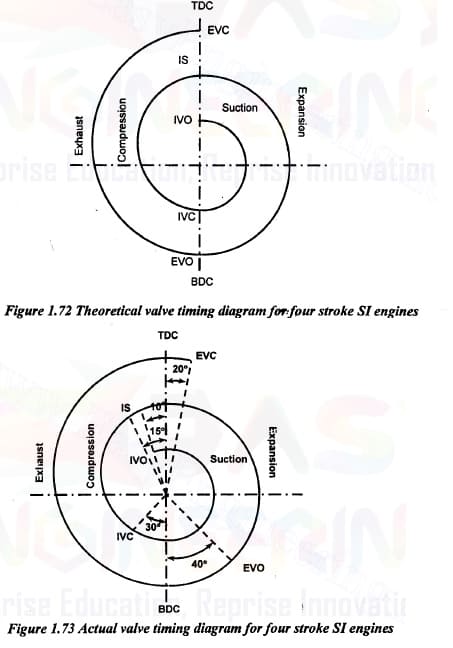 Theoretical and Actual valve timing diagram For Four Stroke SI Engine
 Air Standard Diesel Cycle- Used For Diesel Engine
 Why Single Cylinder two Stroke Petrol Engine used In two Wheeler
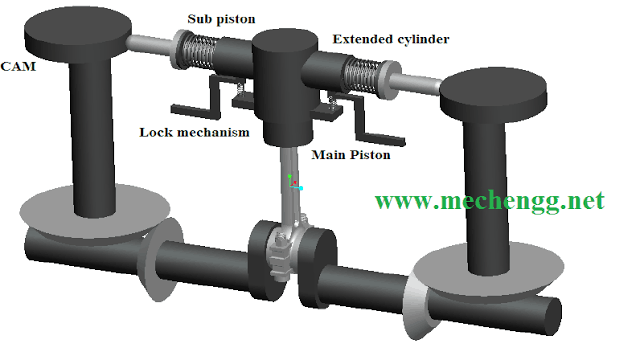 FABRICATION OF VARIABLE VOLUME ENGINE | BUY MECHANICAL PROJECT
 Types Of Engine used In Mechanical Applications