
Abrasive jet machining | interview question and Answers
Abrasive jet machining -interview ,viva, oral question and answers for Mechanical students
1. What is the principle behind abrasive jet machining?
A jet of inert gas consisting of very fine abrasive particles strikes the work piece at high velocity (usually between 200-400 m/sec) resulting in material removal through chipping / erosive action.
See also :Difference between Conventional and Non-Conventional Machining Process
2. What is the mechanism of material removal in AJM?
Erosion. Abrasive jet machining removes material through the action of a focused stream of abrasive-laden gas
3. What are the major subsystems of AJM?
AJM system consists of four major subsystems:
- Gas propulsion system
- Metering system
- Delivery system
- Abrasive collection system

4. Why the abrasive particles not reused in the AJM?
During the process, abrasive particles get contaminated with different gases used in the process, affecting their cutting efficiency; Also the cutting capacity decreases after thefirst application. Further, cost of the abrasive is also low.
5. Why is AJM not suitable for soft materials?
AJM中使用的磨料颗粒可以穿透并嵌入软材料。
6. Name the abrasive materials that are used for the AJM.
The common abrasives used for the AJM process are:
- Dolomite
- Sodium Bicarbonate
- Glass beads
- 碳化硅
- Silicon Nitride
- Alumina
See also ;Seminar | Abrasive Jet Machining full report Download
7. Mention the abrasives used for different applications
Aluminium oxide – Cleaning, cutting and deburring
碳化硅– As above but for harder materials
Glass beads – Matt polishing, cleaning
Crushed- glass Peening, cleaning
Sodium bicarbonate- Cleaning, cutting for soft materials
8. Name different gases used in AJM. Which of this is most widely used?
Dry air
Carbon-di-oxide
Nitrogen
氦
Air is most widely used owing to easy availability and little cost.
9. What is the effect of the grain size on the material removal rate (MRR) in the AJM?
Finer grain sizes are less irregular in shape, and hence, posses lesser cutting ability. Moreover, finer grains tend to stick together and choke the nozzle. The most favourable grain sizes range from 10 to 50m. Larger particle sizes remove the material faster.
10. What is the effect of jet velocity on the MRR in AJM?
The kinetic energy of the abrasive jet is utilised for metal removal by erosion. The jet velocityis a function of the nozzle pressure, nozzle design, abrasive grain size and the meannumber of abrasives per unit volume of the carrier gas. In general with increase in the jet
velocity, the MRR increases.
.
11. Define mixing ratio. What is the effect of mixing ratio on the MRR?
Mixing ratio is the ratio of the volume flow rate of the abrasive per unit time to the volume flow rate of the carrier gas per unit time. A large value of mixing ratio should result in higher rates of MRR but a large abrasive flow rate has been found to adversely influence jet velocity and may sometimes even clog the nozzle.
12. What is the effect of the abrasive powder flow rate on the MRR in AJM?
Increasing the flow rate increases the removal rate because more abrasive particles are available for cutting. However as the powder flow rate is increased, the mass fraction of abrasive in the jet is also increasing. As the mass fraction increases, the abrasive velocity decreases, thus reducing the removal rate.
13. What are common materials used for the nozzle in AJM?
Sapphire and tungsten carbide are the common materials for the nozzle.
14. Why are masks used in AJM? Which material is used for fabrication of masks?
Masks are used to control over spray or to produce large holes and intricate detail without having to move the nozzle and trace the shape. Masks can be fabricated from rubber or metal, each having its advantage and disadvantage. While the rubber masks are easy to fabricate, they give poor edge definition. The metal masks give much better definition but erode faster.
15. Mention the process capabilities (process characteristics) of AJM
- Low MRR
- Intricate details can be produced
- Narrow slots
- Low tolerances
- Minimization of taper
- 薄片,脆弱的材料,无法接近的区域
- Almost no surface damage
16. What are the advantages and limitations of AJM?
Advantages:
- Machining of very hard materials
- Heat sensitive materials can be machined – the gas stream dissipates generated heat when cutting heat-sensitive materials
- Fragile materials can be machined – the small loads transmitted to the workpiece allow the cutting of fragile pieces
- Very low capital cost and low power consumption
- No part shatter or vibration
- The nozzle can be directed towards small, difficult-to-reach areas
Limitations:
- Low material removal rate
- Stray cutting can occur and hence accuracy is not good
- Excessive taper on deep cuts may also be a disadvantage, although the amount of taper can be reduced by tilting the nozzle
- Short nozzle standoff when used for cutting
- Possibility of abrasive particles becoming embedded in the workpiece
- Nozzle wear rate is high
- Process tends to pollute the environment
17. Mention some typical applications of AJM in engineering.
- 从注塑零件中删除闪光灯和分隔线
- Deburring and polishing plastic, nylon and teflon components
- Cleaning metallic mould cavities which otherwise may be inaccessible
- Cleaning oxides from metal surfaces
- Cleaning metallic smears from ceramics
18. What s the principle of WJM?
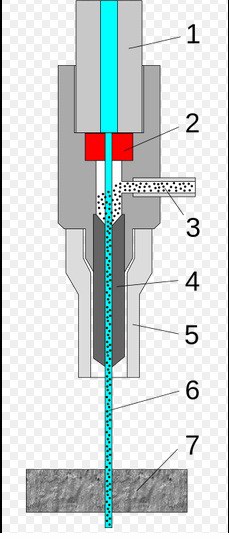
If a jet of water is directed at a target in such a way that, on striking the surface, the high velocity flow is virtually stopped, then most of the kinetic energy of the water is converted into pressure energy. Erosion occurs when this pressure exceeds the strength of the bond binding together the materials making up the target.
介绍水射流加工|先进ntages and Disadvantages
19. What is the mechanism behind the material removal in WJM?
Removes material through the erosion effects of a high velocity, small diameter jet of water.
20. Name the main elements of the WJM system.
- Hydraulic unit
- Intensifier
- Accumulator
- Filters
- Water transmission lines
- On/off valve
- Waterjet nozzles
- Waterjet catchers
- Fluid additives
21.为什么WJM不适合易碎材料?
Brittle materials may crack and break during water jet machining.
22. Why is glass not machined by WJM?
Glass is a brittle material that cracks during WJM.
23. Why is it desirable to keep the standoff distance minimum in the WJM?
SOD is kept minimum in order to prevent the dispersion of water stream before it strikes the workpiece.
24. What are the process parameters that control the results achieved with WJM?
Pressure, nozzle diameter, traverse rate and the SOD, all define the process. Of these, SOD is the least critical.
25. What is the effect of traverse rate on the performance of WJM?
Thicker and denser materials can be cut as the traverse rate decreases. Materials that are too thick to be cut in a single pass can be cut with multiple passes if the first pass can produce a well-defined slot.
26. What is the function of intensifier in WJM?
The intensifier is used to increase the water pressure up to 380MPa – pressure increase is determined by the ratio of the working areas of the two cylinders.
Read also :Basic Of Unconventional Machining | interview Question and Answers
Related posts:
 Abrasive Jet Machining Working, Advantages, Disadvantages and Applications
 Basic Of Unconventional Machining | interview Question and Answers
 Seminar | Abrasive Jet Machining full report Download
 DESIGN AND FABRICATION OF WORKING MODEL OF ABRASIVE JET MACHINE
 Ice Jet Machining Process – Diagram and Working
 介绍水射流加工|先进ntages and Disadvantages
Electro discharge machining ( EDM ) | Interview question and Answers
化学加工 - PCM,ECM,ECH,ECG |面试问题和答案
介绍水射流加工|先进ntages and Disadvantages
Electro discharge machining ( EDM ) | Interview question and Answers
化学加工 - PCM,ECM,ECH,ECG |面试问题和答案