
Table of Contents
Continuously Variable Transmission : Components , Working , Types , Advantages and Disadvantages
CVT或连续可变的变速箱是一种自动,单速和无齿轮变速箱,可以通过无限数量的齿轮比移动。
A continuously variable transmission (CVT) is a transmission that operates on an ingenious pulley system that automatically varies the transmission ratio, allowing an infinite variability between highest and lowest gears with no discrete steps or shifts. CVTs provide more useable power, better fuel economy and a smoother driving experience than traditional transmissions that use gearboxes with fixed numbers of gear sets.
A continuously variable transmission system is a type of automatic transmission in which an arrangement of pulleys and belts made it possible for a drive to achieve n-number of continuous gear ratios within a range (depends on the design).
Read more :Why there is no clutch in gearless scooter – CVT Explained
汽车无级变速传动senses the accelerator input with engine load and get shifted to the desired speed or torque gear ratio automatically, in other words we can say that a cvt transmission is one of the simplest types of automatic transmission that provides continuous uninterrupted power within a specified range of speed and torque ratios.
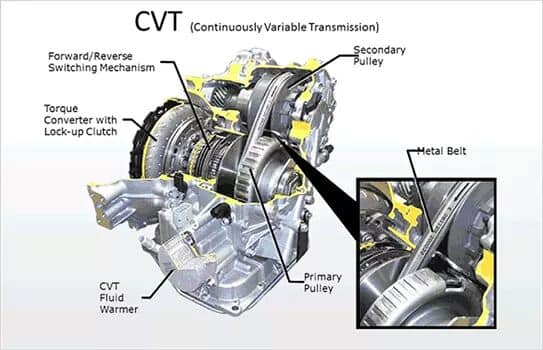
COMPONENTS OF CVT:
1. Clutches
I. Primary clutch
The primary clutch is an advanced form of centrifugal clutch and is typically mounted to the output end of the engine crankshaft. The clutch has two sheave faces; one that is laterally fixed (stationary sheave), and one that can move in and out to engage the belt (moveable sheave). In most systems, at idle the sheave surfaces are spread at their widest spacing, the belt is riding on the post or shaft at the smallest diameter of the clutch, and the belt is not pinched by the sheave faces. This provides a “neutral” position that allows the engine to idle without transmitting power to the wheels.
II. Secondary clutch
第二离合器输入轴安装of the transmission, transaxle, or the like. In modern CVT systems such as those used in recreational vehicles, the secondary clutch has two functions: as a “slave” to the primary clutch and to provide a torque sensing element.
2. Pulleys
In Cvt pulleys play an important role as the conical shape pulleys integrated over input and output shafts are the reason for continuously variable transmission’s continuous n-number of speed and gear ratios, due to the different cross section of these conical pulleys multiple torque and speed ratios are obtained.
Two pair of conical pulleys each for input and output shafts are used in a basic continuously variable transmission that are-
1.固定输入皮带轮 -
It is a conical pulley mounted over the input shaft (on the right-hand side), this pulley does not move (too and fro) over the shaft but rotates with the input shaft, usually fixed pulley is smaller in size.
2.固定输出皮带轮
It same as fixed input pulley but unlike fixed input shaft this shaft is placed on the left-hand side over the output shaft.
3. Feeding input pulley or sheave-
它是安装在输入轴上的圆锥形皮带轮类型,并具有内部的花纹与轴链条融合在一起,以这种方式可以移动(也是如此),并与输入轴一起旋转。在输入轴上,该轴的来回矩使齿轮比率成为可能。
4. Feeding output pulley or sheave
与移动输入皮带轮相同,但与移动输入轴不同,该轴位于输出轴上的右侧。
3. Shafts
Same as manual transmission type 2 shafts are needed by Cvt transmission to transfer power from engine to the final drive that are-
1. Input shaft-
与手动变速箱相同,它是一种在安装输入皮带的横截面上带有花纹的轴类型,该输入轴的电源源是发动机,这意味着连续可变的变速器通过输入轴从发动机中获取输入。
2. Output shaft-
It is the type of shaft which is kept parallel to the input shaft in a continuously variable transmission, same as input shaft it also has splines over its cross-section and is mounted upon by output pulleys.
Output shaft is responsible to transmit final output power to the final drive of the vehicle.
4. Belt or Chain
The belt in most CVT systems is a heavy duty “V-belt” which is V-shaped in cross section. They are made of rubber components reinforced with Kevlar and other materials to enhance durability.
In a Cvt transmission a v-shaped metallic (rubber in some case) chain or belt is used to transmit power from input pulleys to the output pulleys as this belt or chain is wrapped over both conical input and output pulleys pairs and the V-shape of this belt or chain make it possible to shift gears from high torque to the high speed.
HOW CVT WORKS?
CVT使用皮带轮和皮带系统来改变车辆的车轮速度和相对于发动机速度和扭矩的扭矩,从而提供无限范围的齿轮比。它与具有设定的齿轮比的自动变速箱不同。CVT使用诸如高密度橡胶/金属皮带,液压缸驱动的滑轮,一种机械扭矩驱动皮带轮,传感器和微处理器来执行其功能的组件。
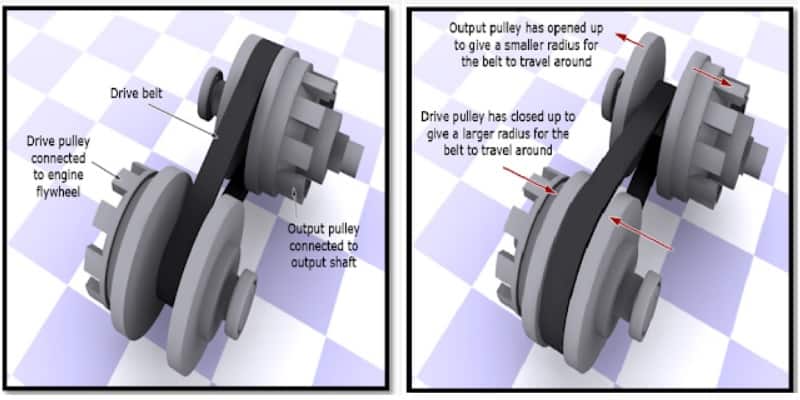
传输具有通过最大值和最小值之间的无限齿轮比率连续变化的能力。为了促进不同的齿轮比,需要改变传输中两个主要皮带轮的工作直径。虽然连接到发动机的皮带轮称为输入皮带轮,但连接到驱动轮的滑轮称为输出皮带轮。皮带轮的一侧是固定的,而另一侧是可移动的。这种运动是通过液压缸来促进的,该液压缸可以改变皮带轮的两侧之间的空间。当皮带轮一半彼此靠近时,它们之间的皮带在皮带轮上更高,从而增加了皮带轮的直径。
This is how you get the unlimited gear ratios, unlike the traditional transmission, where the ratio is changed in stages by shifting gears.
TORQUE RATIOS
when a vehicle needs high torque ratios the feeding input conical pulley (sheave) over the input shaft moves away from the fixed pulley which in turn shift part of the v-belt wrapped over the input pulleys towards the lower cross-sectional part of the conical pulley.
同时,当此输入皮带轮(滑轮)移动时,进料滑轮(Sheave)也会移动并更接近固定输出皮带轮,而固定输出皮带轮又移动了V型皮带的一部分,将V形皮带包裹在输出皮带轮上,朝向更大的横截面区域达到了输出锥形皮带轮和所需的扭矩比。
SPEED RATIOS
when the vehicle needs speed ratios, the feeding conical pulley (sheave) over the input shaft moves towards the fixed pulley which in turn shifts the part of v-shaped belt wrapped over the input pulleys towards the greater cross-sectional part of the conical input pulleys.
Simultaneously with this movement of input pulley, feeding output pulley (sheave) also moves and go away from the fixed pulley which in turn moves the part of the v-shaped belt wrapped around the output pulleys towards the lower cross-sectional part of the conical output pulleys and desired speed ratio is attained.
In other words, torque ratios are achieved when the v-belt rotates at the lower cross section of the input pulleys and at the greater cross section of the output pulley.
当V带在输入皮带轮的较高横截面和输出皮带轮的较低横截面时,V带旋转时,可以实现速度比。
TYPES OF CVT
1. Pulley Based
Compared to manual or automatic transmission systems, the design of a pulley-based CVT is simpler, with a lesser number of parts involved. The prime parts involved in such a system, are a variable diameter input pulley, an output pulley, and a V-belt that connects these two pulleys, along with several electronic devices. A change in gear ratios is achieved through the variation of distance between the pulleys and their variable diameter.
2. Toroidal CVT
This second type of design is similar in principle to a pulley-based CVT but still slightly different. The parts involved here are power rollers and discs, instead of pulleys and belts. There are two disks involved with two rollers in between. The gear ratios are changed through the use of an ingenious mechanism, which involves a peculiar arrangement of the disk and rollers. The rollers control the torque distribution and make infinitely many gear ratios possible, between the two extremes.
3. Hydrostatic CVT
这些类型的CVT系统使用静水泵和电动机作为组成部分。通过流体位移使扭矩分布成为可能,并且您可以选择连续的齿轮比。由于使用液压和消除易于摩擦的接触点,您的传输问题大大降低了。
的优点和缺点
Advantages
• Better fuel consumption than a regular automatic transmission as the CVT is able to keep the car in its optimum power range regardless of speed
•由于经历了较低的功率损失,加速有所改善
• Stepless transmission
• It has the ability to allow the engine to rev almost immediately which delivers maximum torque.
• Provides a smoother ride than automatic transmission
•静水CVT的液压电动机可以直接安装在轮毂上,这使得更加灵活的悬架系统,这反过来又消除了由于驱动轴的摩擦而导致的效率损失。
• Adapts to varying road conditions and power demands to allows for a better ride
• Better emission control and less greenhouse gas emissions because of improved control of the engine’s speed range.
Disadvantages
•用CVT驾驶车辆是一种截然不同的体验,许多驾驶员不喜欢它,因为您不会感到发动机加速;您不会感觉到任何变化,而是感觉到发动机赛车,就像滑动离合器或失败的变速箱一样,这只是CVT调整以提供最佳功率。
• Higher cost
• Belt-driven CVTs (VDP system) have a limited amount of torque, however the technology is constantly being improved.
• Transmitting motion by friction causes greater wear
• Require special oil and other materials
更多资源 /文章
Latest seminar topic index - Report ,PPT Download
Automobile Engineering Parts and System Notes , Article
Automobile Trends , News articles , Notes
2020188金宝搏怎么样年新机械项目(所有项目索引列表)
Related posts:
 Fabrication and Analysis Of A Continuously Variable Planetary Transmission System
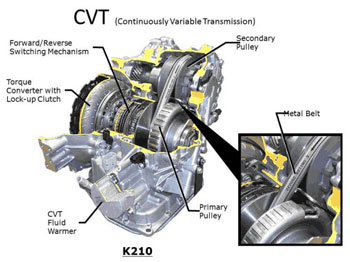 Seminar On Continuously Variable Transmission (CVT) Report
 Manual Transmission | Components , types , Working and Application
 Why there is no clutch in gearless scooter – CVT Explained
 Types of Transmission system l Comparison between manual and automatic transmission
 6种主要类型的汽车传输系统
 Types Of Belt Drives Used For Power Transmission and Industrial Uses
 螺旋桨轴|功能,类型,组件和需求