
What is Fuel Cell – Types of Fuel Cell
What is Fuel Cell ?
燃料电池使用氢或另一种燃料的化学能,以清洁和有效地产生电力。如果氢是燃料,电力,水和热量是唯一的产品。燃料电池在其各种潜在应用方面是独特的;它们可以为系统提供大量作为公用电站的系统,并且可以像笔记本电脑一样小。
燃料电池如何工作
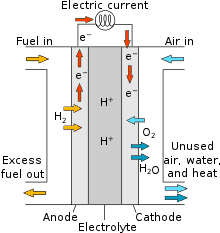
Fuel cells work like batteries, but they do not run down or need recharging. They produce electricity and heat as long as fuel is supplied. A fuel cell consists of two electrodes—a negative electrode (or anode) and a positive electrode (or cathode)—sandwiched around an electrolyte. A fuel, such as hydrogen, is fed to the anode, and air is fed to the cathode. In a hydrogen fuel cell, a catalyst at the anode separates hydrogen molecules into protons and electrons, which take different paths to the cathode. The electrons go through an external circuit, creating a flow of electricity. The protons migrate through the electrolyte to the cathode, where they unite with oxygen and the electrons to produce water and heat.
Types of fuel cells
基于电解质类型的分类
- Phosphoric acid fuel cell (PAFC)
- Polymer electrolyte membrane fuel cell (PEMFC)
- Alkaline fuel cell (AFC)
- Molten carbonate fuel cell (MCFC)
- Solid oxide fuel cell (SOFC)

Fuel cells come in many varieties; however, they all work in the same general manner. They are made up of three adjacent segments: the anode, the electrolyte, and the cathode. Two chemical reactions occur at the interfaces of the three different segments. The net result of the two reactions is that fuel is consumed, water or carbon dioxide is created, and an electric current is created, which can be used to power electrical devices, normally referred to as the load.
质子交换膜燃料电池(PEMFC)
聚合物电解质膜(PEM)燃料电池 - 也称为质子交换膜燃料电池 - 提供高功率密度,与其他燃料电池相比,重量和体积低的优点。PEM燃料电池使用固体聚合物作为电解质和含有铂或铂合金催化剂的多孔碳电极。他们只需要氢气,空气中的氧气和水进行操作。它们通常用从储罐或重整器供应的纯氢气燃料。
Alkaline fuel cells
碱性燃料电池(AFCS)是开发的第一款燃料电池技术之一,它们是美国空间程序中广泛应用于生产电能和水的航天器。这些燃料电池使用氢氧化钾在水中作为电解质溶液,并且可以在阳极和阴极处使用各种非贵金属作为催化剂。近年来,已经开发出用聚合物膜作为电解质的新型AFC。这些燃料电池与常规PEM燃料电池密切相关,不同之处在于它们使用碱性膜而不是酸性膜。AFC的高性能是由于电气化反应在细胞中发生的速率。它们还证明了太空应用中60%以上的效率。
Molten carbonate fuel cells
Molten carbonate fuel cells (MCFCs) are currently being developed for natural gas and coal-based power plants for electrical utility, industrial, and military applications. MCFCs are high-temperature fuel cells that use an electrolyte composed of a molten carbonate salt mixture suspended in a porous, chemically inert ceramic lithium aluminum oxide matrix. Because they operate at high temperatures of 650°C (roughly 1,200°F), non-precious metals can be used as catalysts at the anode and cathode, reducing costs.
Solid oxide fuel cells
Solid oxide fuel cells (SOFCs) use a hard, non-porous ceramic compound as the electrolyte. SOFCs are around 60% efficient at converting fuel to electricity. In applications designed to capture and utilize the system’s waste heat (co-generation), overall fuel use efficiencies could top 85%.
SOFC在非常高的温度下操作 - 高达1,000°C(1,830°F)。高温操作消除了对珍贵金属催化剂的需求,从而降低了成本。它还允许SOFC在内部进行改革燃料,这使得能够使用各种燃料并降低与向系统添加重整器相关的成本。
Related posts:
 What is Load Cell- Working And Application Of Load Cell
 Design and Fabrication on Hydrogen engine (Water fuel) – Mechanical Project
 Electro Chemical Machining -Parameter, Advantages and Disadvantages
 踏板操作手机充电器
 Biogas as Fuel in IC Engine | Advantages and Disadvantages
 Liquefied Petroleum Gas | LPG as a fuel For IC Engines
 什么是电力抛光 - 优点和缺点
 Natural Gas as Engine Fuel | Advantages and Disadvantages