
Introduction to Bernoulli’s equation and It’s Application
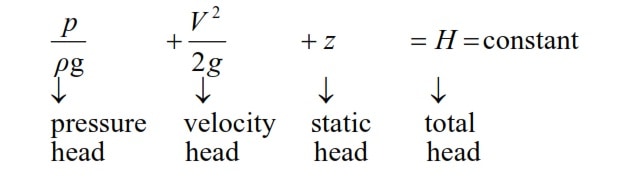
Each term in the above equation hasdimensions of length(i.e., meters in SI units) hence these terms are called aspressure head, velocity head, static headandtotal headsrespectively.
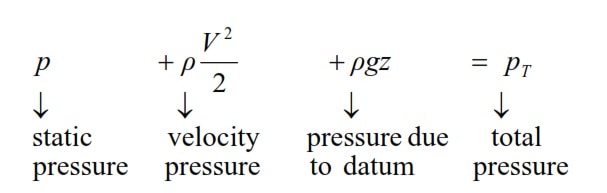
Bernoulli’s equation can also be written in terms of pressures (i.e.,Pascals in SI units) as:
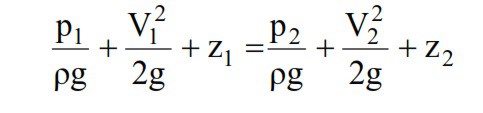
Bernoulli’s equation is valid betweenany two pointsin the flow field when the flow is steady, irrotational, in-viscid and incompressible. The equation is valid along a streamline for rotational, steady and incompressible flows. Between any two points 1 and 2 in the flow field for irrotational flows, the Bernoulli’s equation is written as:
Bernoulli’s equation can also be considered to be analternate statement of conservation of energy (1stlaw of thermodynamics).
Refer this ;Fundamental laws of Thermodynamics
由于所有实际流体都有有限的粘度,即在所有实际的流体流动中,一些能量将在克服摩擦时丢失。这被称为头部损失,即,如果流体在垂直管道上升,则它将上升到较低的高度,而不是Bernoulli方程所预测的。头部损耗将导致流量的压力降低,方程也意味着将一种压力转化为其他形式的可能性。For example,neglecting the pressure changes due to datum, it can be concluded from Bernoulli’s equation that the static pressure rises in the direction of flow in a diffuser while it drops in the direction of flow in case of nozzle due to conversion of velocity pressure into static pressure and vice versa. Figure 1 shows the variation of total, static and velocity pressure for steady, incompressible and inviscid, fluid flow through a pipe of uniform cross-section.方向。如果HEAD损耗由H表示,则伯努利的等式可以修改为:
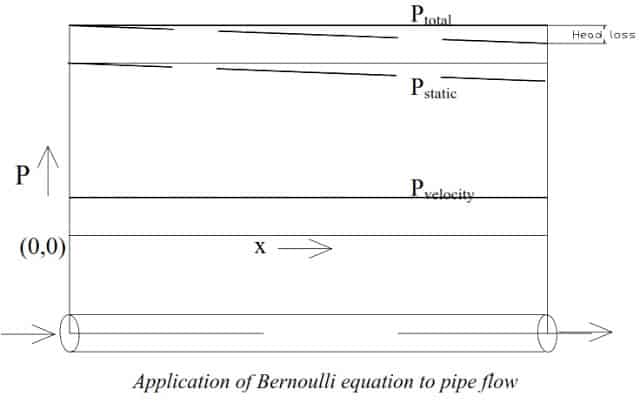
Figure 1 shows the variation of total, static and velocity pressure for steady, incompressible fluid flow through a pipe of uniform cross-section without viscous effects (solid line) and with viscous effects (dashed lines)
More Resources /articles
Fluid Mechanics - Notes , articles , Interview Que. & Ans
Industrial Engineering Notes , Articles , Interview Que & Ans
Mechanical Subjectwise Basic Concept Notes ,Articles
Related posts:
 Basic Concepts | Fluid Mechanics – Interview Question and Answers
 Types of Flows in a Pipe /Fluid Mechanics
Fluid mechanics Basic | Interview Question and Answers
Types of Flows in a Pipe /Fluid Mechanics
Fluid mechanics Basic | Interview Question and Answers
 Venturimeter – Parts, Diagram, Working, Advantages, Application
 Steam Nozzle – Definitions, Types, Efficiency, Application
 Basic concepts of Fluid Mechanics | Gate Mechanical Notes
 Orifice Meter – Diagram, Working, Application, Advantages, Disadvantages
 Thermodynamics Basic Objective Type Question And Answers