Laser Beam Welding Process – Principle, Advantages , Disadvantages
Principles:
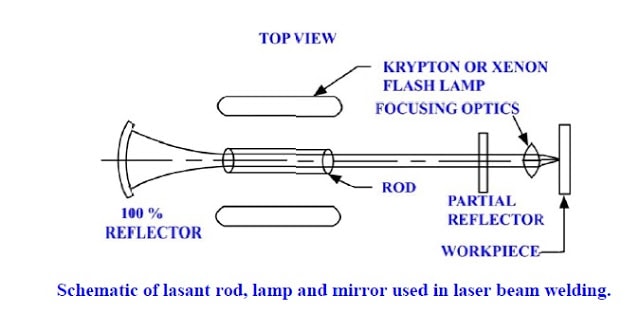
Laser is an acronym for light amplification by stimulated emission of radiation. Laser Beam Welding (LBW) is a fusion joining process that produces coalescence of materials with the heat obtained from a concentrated beam of coherent, monochromatic light impinging on the joint to be welded. In the LBM process, the laser beam is directed by flat optical elements, such as mirrors and then focused to a small spot (for high power density) at the workpiece using either reflective focusing elements or lenses. It is a non-contact process, requiring no pressure to be applied. Inert gas shielding is generally employed to prevent oxidation of the molten puddle and filler metals may be occasionally used. The Lasers which are predominantly being used for industrial material processing and welding tasks are the Nd-YAG laser and 1.06 μm wavelength CO2 laser, with the active elements most commonly employed in these two varieties of lasers being the neodymium (Nd) ion and the CO2 molecules respectively. Laser Beam Welding Process diagram
Laser Types:
Solid-State laser:
It utilizes an impurity in a host material as the active medium. Thus, the neodymium ion (Nd+++) is used as a ‘dopant’, or purposely added impurity in either a glass or YAG crystal and the 1.06 μm output wavelength is dictated by the neodymium ion. The lasing material or the host is in the form of a cylinder of about 150 mm long and 9 mm in diameter.
Gas Lasers:
The electric discharge style CO2 gas lasers are the most efficient type currently available for high power laser beam material processing. These lasers employ gas mixtures primarily containing nitrogen and helium along with a small percentage of carbon dioxide, and an electric glow discharge is used to pump this laser medium (i.e., to excite the CO2 molecule). Gas heating produced in this fashion is controlled by continuously circulating the gas mixture through the optical cavity area and thus CO2 lasers are usually categorized according to the type of gas flow system they employ; slow axial, fast axial or transverse.
Slow Axial Flow Gas Laser:
They are the simplest of the CO2 gas lasers. Gas flow is in the same direction as the laser resonator’s optical axis and electric excitation field, or gas discharge path.
Fast Axial Flow (FAF) Gas Laser:
They have similar arrangement of components as that of slow axial flow gas laser, except that in the case of the FAF Laser, a roots blower or turbo pump is used to circulate the laser gas at high speed through the discharge region and corresponding heat exchangers. The FAF lasers with continuous wave (CW) output power levels of between 500 to 6000 watts are available.
Transverse Flow:
These lasers operate by continuously circulating gas across the resonator cavity axis by means of a high speed fan type blower, while maintaining an electric discharge perpendicular to both the gas flow direction and the laser beam’s optical axis. Transverse flow lasers with output power levels between 1 and 25 kW are available.
LBW Process Advantages:
Major advantages of Laser Beam Welding include the following:
1) Heat input is close to the minimum required to fuse the weld metal, thus heat affected zones are reduced and workpiece distortions are minimized.
2) Time for welding thick sections is reduced and the need for filler wires and elaborate joint preparations is eliminated by employing the single pass laser welding procedures.
3) No electrodes are required; welding is performed with freedom from electrode contamination, indentation or damage from high resistance welding currents.
4) LBM being a non-contact process, distortions are minimized and tool wears are eliminated.
5) Welding in areas that are not easily accessible with other means of welding can be done by
LBM, since the beams can be focused, aligned and directed by optical elements.
6) Laser beam can be focused on a small area, permitting the joining of small, closely spaced components with tiny welds.
7) Wide variety of materials including various combinations can be welded.
8) Thin welds on small diameter wires are less susceptible to burn back than is the case with arc welding.
9) Metals with dissimilar physical properties, such as electric resistance can also be welded.
10) No vacuum or X-Ray shielding is required.
11)激光焊缝不受磁5lds, as in arc and electron beam welds. They also tend to follow weld joint through to the root of the work-piece, even when the beam and joint are not perfectly aligned.
12) Aspect ratios (i.e., depth-to-width ratios) of the order of 10:1 are attainable in LBM.
Limitations of the LBM Process:
1) Joints must be accurately positioned laterally under the beam and at a controlled position with respect to the beam focal point.
2) In case of mechanical clamping of the weld joints, it must be ensured that the final position of the joint is accurately aligned with the beam impingement point.
3) The maximum joint thickness that can be welded by laser beam is somewhat limited. Thus weld penetrations of larger than 19 mms are difficult to weld.
4) High reflectivity and high thermal conductivity of materials like Al and Cu alloys can affect the weldability with lasers.
5) An appropriate plasma control device must be employed to ensure the weld reproducibility while performing moderate to high power laser welding.
6) Lasers tend to have fairly low energy conversion efficiency, generally less than 10 percent.
Sachin is a B-TECH graduate in Mechanical Engineering from a reputed Engineering college. Currently, he is working in the sheet metal industry as a designer. Additionally, he has interested in Product Design, Animation, and Project design. He also likes to write articles related to the mechanical engineering field and tries to motivate other mechanical engineering students by his innovative project ideas, design, models and videos.
Introduction to Pressure Vessels Vessels, tanks, and pipelines that carry, store, or receive fluids are called pressure vessels. A pressure vessel is defined as a container with a pressure...
指骨关节铰链接合是用来连接two rods which are under the action of tensile loads. However, if the joint is guided, the rods may support a compressive load. A knuckle joint...