
Table of Contents
Seminar On Hybrid Cars /Hybrid Electric Vehicles (HEV) Full Report PDF Download
ABSTRACT
Have you pulled your car up to the gas pump lately and been shocked by the high price of gasoline? As the pump clicked past $20 or $30, maybe you thought about trading in that SUV for something that gets better mileage. Or maybe you are worried that your car is contributing to the greenhouse effect. Or maybe you just want to have the coolest car on the block. Currently, there is a solution for all this problems; it’s the hybrid electric vehicle.
The vehicle is lighter and roomier than a purely electric vehicle, because there is less need to carry as many heavy batteries. The internal combustion engine in hybrid-electric is much smaller and lighter and more efficient than the engine in a conventional vehicle. In fact, most automobile manufacturers have announced plans to manufacture their own hybrid versions. Hybrid electric vehicles are all around us. Most of the locomotives we see pulling trains are diesel-electric hybrids. Cities like Seattle have diesel-electric buses — these can draw electric power from overhead wires or run on diesel when they are away from the wires. Giant mining trucks are often diesel-electric hybrids. Submarines are also hybrid vehicles — some are nuclear-electric and some are diesel-electric. Any vehicle that combines two or more sources of power that can directly or indirectly provide propulsion power is a hybrid.
INTRODUCTION
The world started down a new road in 1997 when the first modern hybrid electric car, the Toyota Prius, was sold in Japan. Two years later, the United States saw its first sale of a hybrid, the Honda Insight. These two Vehicles, followed by the Honda Civic Hybrid, marked a radial change in the type of car being offered to the public: vehicles that bring some of the benefits of battery electric vehicles into the conventional gasoline powered cars and trucks we have been using for more than 100 years. In the coming years, hybrids can play a significant role in addressing several of the major problems faced by the United States and the whole world today: climate change, air pollution and oil dependence. Whether this new technology delivers on its promise hinges on the choices automakers, consumers and policymakers make over the coming years. Poor choices could result in hybrids that fall short even of what conventional technology could deliver on fuel economy, emission or both. If they designed well, these hybrids can equal or better the utility, comfort, performance and safety we’ve come to expect, while saving us thousand of dollars at the gas pump.
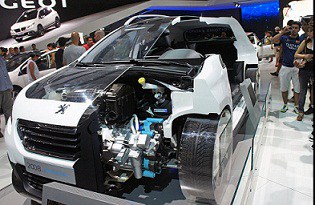
What is HEV?
- Thecombination of an internal combustion engine(ICE) with one or more electric motor or generators and a battery pack
- Combines propulsion system with RESS and gets better fuel economy
- An HEV uses less gasoline because the electric motor does some of the work
Working Of Hybrid Cars
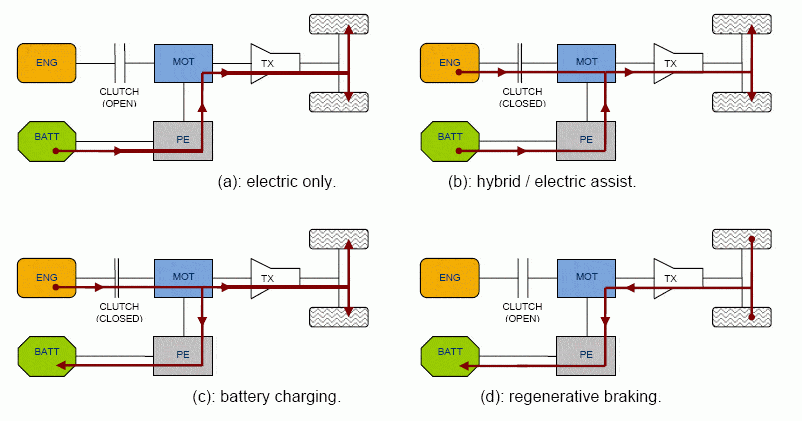
Overview
- Full hybrids use a gasoline engine as the primary source of power and an electric motor provides additional power when needed
- In addition, full hybrids can use the electric motor as the electric motor as the sole source of propulsion for low-speed, low-acceleration driving, such as in stop-and-go traffic or for breaking up.
- This electric-only driving mode can further increase fuel efficiency under some driving conditions.
Starting
- When a full hybrid vehicle is initially started, the battery typically powers all accessories
- The gasoline engine only starts if the battery needs to be charged or the accessories require more power than available from the battery
- The battery stores energy generated from the gasoline engine or during regenerative braking from the electric motor. Since the battery powers the vehicle at low speeds, it is larger and holds much more energy than battery used to start conventional vehicles
Low speed
- For initial acceleration and low-speed driving, as well as reverse, the electric motor uses electricity from the battery to power the vehicle
- If the battery needs to be recharged, the generator starts the engine and converts energy from the engine into electricity. This is stored in the battery.
Cruising
- At speeds above mid-range, both the engine and electric motor are used to propel the vehicle
- The gasoline engine provides power to the drive-train directly and to the electric motor via the generator
- During heavy accelerating or when additional power is needed the gasoline engine and electric motor are both use to propel the vehicle
Braking part
- Regenerative braking converts otherwise wasted energy from baking into electricity and stores it in battery
- In regenerative braking, the electric motor is reversed so that, instead of using electricity to run the wheels, the rotating wheels turn the motor and create electricity. Using energy from the wheels turn the motor slows the vehicle down
Stopped
- When the vehicle is stopped, such as at a red light, the gasoline engine and electric motor shut off automatically so that energy is not wasted idling
- All other systems, including the electric air conditioning, continue to run
Battery:The battery stores energy generated from the gasoline engine or, during regenerative braking, from the electric motor. Since the battery powers the vehicle at low speeds, it is larger and holds much energy than batteries used to start conventional vehicles.
ADVANTAGES OF HEV
- Environmental
- Energy resilience
- Energy efficiency
- Cost of recharge
- Stabilization of the grid
- Use less fuel
- Lighter batteries
- Value Added Features
DISADVANTAGES OF HEV
- Heating of electric vehicles
- Reduced but not emission free
- More expensive e than conventional vehicles
- Has a payback period in average use
List Of Latest Hybrid Vehicles:
Toyota Toyota Prius c hybrid
Toyota Toyota Prius Plug-in Hybrid
Toyota Toyota Yaris Hybrid
Toyota Toyota Camry Hybrid 2nd generation
Honda Acura ILX Hybrid
Toyota Lexus ES 300h
BMW BMW ActiveHybrid 5
BMW BMW ActiveHybrid 3
Ford Ford Fusion Hybrid 2nd generation
Ford Ford C-Max Hybrid
Ford Ford C-Max Energi plug-in hybrid
沃尔沃,沃尔沃V60插电式混合动力车(柴油)
Volkswagen Volkswagen Jetta Hybrid
Toyota Toyota Avalon Hybrid
Ford Ford Fusion Energi plug-in hybrid
Mitsubishi Mitsubishi Outlander P-HEV
Honda Honda Accord Plug-in Hybrid
BMW BMW i3 REx
Fisker Fisker Surf
General Motors Cadillac ELR plug-in hybrid
McLaren McLaren P1
Ferrari LaFerrari
BMW BMW i8
Download:
Seminar On Hybrid Cars /Hybrid Electric Vehicles (HEV) Full Report PDF Download
File Size: 700 Kb
More Resources /articles
Latest seminar topic index - Report ,PPT Download
Mechanical Subjectwise Basic Concept Notes ,Articles
New Mechanical Projects 2020 ( All Projects Post Index List )
Automobile Engineering Parts and System Notes , Article
Related posts:
 Hybrid Electric Vehicles | Seminar Report Pdf Free Download
 Fabrication of Hybrid (Petrol and Electric) Motorcycle Vehicle
 Design and Fabrication of Two Wheeler Hybrid Vehicle
 Seminar On Cryocars | Full report pdf PPT Download-Mechanical Seminar
 Seminar On EXHAUST GAS RECIRCULATION Full report PPT/PDF Download
 What is Hybrid Synergy Drive (HSD) – How it works ?
 Electric Vehicle | Components And Working Principle
 Design and Fabrication of frictionless energy generation using flywheel for electric vehicles