
目录
废气再循环|工作原理,设计和利益
柴油发动机倾向于散发出对人类有害的较高的氮(NOX)。这是因为由于压缩比较高,发动机缸的高温。为了控制和减少NOX,制造商在发动机中采用“排气再循环”技术。
The term EGR stands for Exhaust Gas Recirculation. It is a part of modern-day diesel engine vehicles which helps to decrease the Nitrogen Oxide (NOx) emissions. Exhaust Gas Recirculation is the technique used for reducing the nitrogen oxide in both the internal combustion diesel engines as well as petrol engines.
阅读更多 ;Seminar On EXHAUST GAS RECIRCULATION Full report PPT/PDF Download
WORKING PRINCIPLE
The exhaust gas, added to the fuel, oxygen, and combustion products, increases the specific heat capacity of the cylinder contents, which lowers the adiabatic flame temperature.

在典型的汽车火花点燃(SI)发动机中,将5%至15%的废气作为EGR路由回到摄入量。最大数量受到混合物在燃烧事件期间维持连续火焰前线的需求的限制;设置不佳的应用程序过多的EGR会导致失火和部分燃烧。尽管EGR确实可以测量缓慢的燃烧,但可以通过推进火花时机在很大程度上得到补偿。EGR对发动机效率的影响很大程度上取决于特定的发动机设计,有时会导致效率和NOX排放之间的妥协。
正确运行的EGR理论上可以通过几种机制提高汽油发动机的效率:
• Reduced throttling losses.
在进气系统中添加惰性废气意味着,对于给定的功率输出,必须进一步打开节气门板,从而导致进水歧管压力增加并减少节流损失。
•减少热排斥。
Lowered peak combustion temperatures not only reduces NOx formation, it also reduces the loss of thermal energy to combustion chamber surfaces, leaving more available for conversion to mechanical work during the expansion stroke.
• Reduced chemical dissociation.
较低的峰值温度导致更多的释放能量在TDC附近(顶部死亡中心)附近保持合理的能量,而不是在燃烧产物解离时(在膨胀中风的早期)绑定(早期)。与前两个相比,这种效果很小。
EGR is typically not employed at high loads because it would reduce peak power output. This is because it reduces the intake charge density. EGR is also omitted at idle (low-speed, zero load) because it would cause unstable combustion, resulting in rough idle.
Since the EGR system recirculates a portion of exhaust gases, over time the valve can become clogged with carbon deposits that prevent it from operating properly. Clogged EGR valves can sometimes be cleaned, but replacement is necessary if the valve is faulty.
DESIGN
A vacuum controlled EGR valve regulates the amount of exhaust gases admitted into the cylinders. It consists of a spring-loaded vacuum diaphragm. It links to a metered valve which controls the passage of the exhaust gases. Ported vacuum from a calibrated signal port located above the throttle valve connects to the EGR vacuum chamber.
在空闲时,由于弹簧压力和下端口的真空,EGR阀处于闭合位置。工程师将其设计之所以设计,是因为如果废气在空转处循环,则会导致粗糙/不稳定的空转。开放后,油门会应用端口的真空并逐渐打开锥形阀。这会导致废气流入进气歧管。
However, when the throttle opens fully, there is no vacuum in the intake manifold. So, it closes the tapered valve and stops the exhaust gases from entering the intake manifold.
好处
废气再循环系统通过燃烧室将一部分废气循环回发动机缸。EGR系统背后的逻辑非常简单。废气比发动机吸吮的新鲜空气更热。因此,废气大大减少了气缸的含量以燃烧。由于没有氧气(O2),因此废气没有燃料也没有燃料,也没有氧气颗粒。
Thus, it results in lower heat discharge and cylinder temperatures. It reduces the formation of nitrogen oxide (NO2) as well. The dormant exhaust gas present in the cylinder also limits the peak temperatures. It also reduces the loss that arises because of throttling in petrol engines while improving the engine life by reducing the cylinder temperatures. The three-stage catalytic converter further reduces the NOx to acceptable levels.
限制
The engineers designed the EGR system in such a way that it recirculates the exhaust gases only when the engine forms the Nitrogen Oxide (NOx). Thus, the EGR system DOES NOT affect the ‘Full-Load’ operation. The Exhaust Gas Recirculation system also has a thermal control valve in the vacuum line which prevents the operation of EGR at lower engine temperatures. This system is useful especially in the diesel engines where the catalytic converter cannot stimulate the chemical reduction due to high oxygen contents. So, the NOx emission remains the same in such conditions.
机械主题基本概念注释,文章
最新研讨会主题索引 - 报告,ppt下载
汽车工程Parts and System Notes , Article
Simple , Easy mechanical projectsManually Hand Operated projectsAffordable low budget Projects迷你低成本项目
New Mechanical Projects 2020 ( All Projects Post Index List )
相关文章:
 Seminar On EXHAUST GAS RECIRCULATION Full report PPT/PDF Download
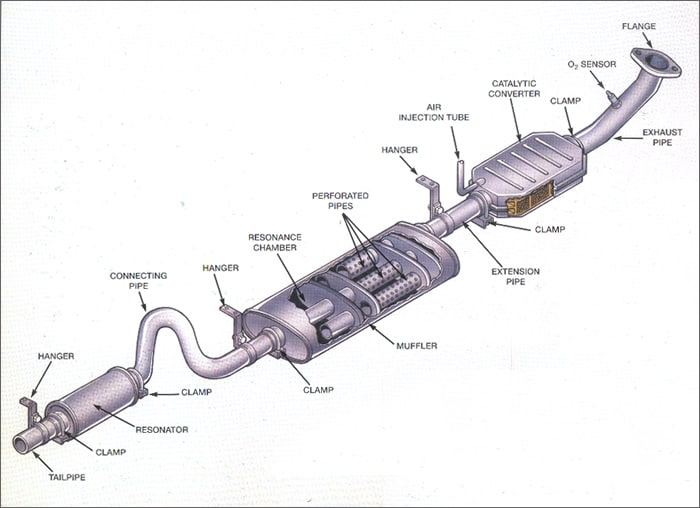 Exhaust System | Components and Their Functions
 废烟|颜色(黑色,白色,蓝色)及其原因
 What is VVT | Variable Valve Timing ( VVT ) Diagram
 What is Lean Burn Engine | Working , Advantages and Disadvantages
 Introduction to Turbochargers-Working, Advantages, Disadvantages of TurboChargers
 Two Stroke Engine : Parts , Cycle , Diagram , Working , Application
 什么是汽车排放 - 汽车排放污染物