目录
什么是铸造核心打印——使用核心打印吗
通常需要具有不同尺寸和形状的孔,凹槽等所必需的铸件。使用核心可以获得此模仿。所以在需要取芯的情况下,如果应该准备握住模具腔内的芯。核心打印用于提供此功能。核心印刷品正在图案上添加投影,它在模具中形成座椅,砂芯通过倒入模具。核心印花必须具有足够的尺寸和形状,使得它可以在铸造过程中保持核心的重量。根据要求,核心可以位于水平,垂直,并且可以悬挂在模腔中。
Meaning of Core Moulding:
芯是预定成型的干砂,其与模具分开制成。它位于模具中以在铸件中获得形状,该形状不能正确地通过模具获得。核心盒式设备,烘焙设备和搬运设施是制作核心所必需的。
Core can be eliminated when of small size particularly, if the hole is to be machined. Cores should be of sufficient thickness and free of fragile or overhanging projections, which might be easily broken during the necessary handling and transportation involved in production.
用于核心的材料:
The main material of the core is refractory, either a natural or a synthetic sand. The sand-mix used for core making consists of the sand together with a binder which is used to give strength after baking. A natural binder (sometimes called core-gum) is linseed oil. A synthetic binder is a synthetic resin.
最近的发展是将硅酸钠溶液混合,使得晶粒通过用二氧化碳的“气体”涂覆并获得必要的硬度,使硅酸钠将晶粒粘合在一起并产生强芯,从而消除烘焙过程。
Core Binder:
由于用于制备核心的纯砂没有天然键,因此使用粘合剂。芯粘合剂是加入沙子的药剂,以产生良好的“绿色”键,烘烤后的硬度。典型的天然粘合剂是亚麻籽油;典型的合成粘合剂是热固性型的树脂。
Generally, core oils (composed of 50 to 60% linseed oil, 25% resin and balance mineral oil) are used as they are very economical to produce better cores. In the case of thermoplastic binders (resin and pitch), the powdered binder is mixed with core sand, and on heating the binder liquefies and coats the sand grains.
On cooling, the dispersed liquid binds the sand grains together to form a united mass. Use of synthetic resins is limited as they are costly. Addition of resin to core oil speeds up drying of core and reduces the volume of core gas. Pitch compounded with dextrin and steam coal is used for large cores.
Phenol and urea formaldehyde thermo setting plastic core binders are becoming common due to their high strength, low gas formation, collapsibility and resistance to moisture absorption.
糖蜜为核心增加了硬度,但缺乏力量。在核心上,也可以喷涂糖蜜水。
使用蛋白质粘合剂(明胶,胶水,群群等),其中可折叠是主要标准。
加强核心:
除了非常小的核心外,这些内部用芯线或栅格内部加固,以帮助核心在潮湿的同时保持其形状,用于运输和加强目的。
Types of Cores:
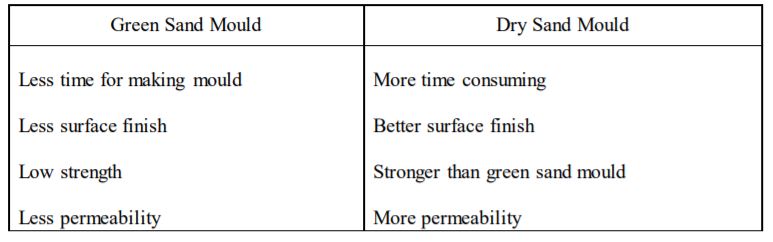
Cores are generally made of green sand or dry sand. The green sand cores have relatively low strength being made of green sand, whereas dry sand cores are made of sand and special binders which develop strength when baked.
These could also be classified according to their position or use, according to which these can be of horizontal, vertical, balanced, drop and other types. These four types will be clear from Fig.

Horizontal and vertical cores are used more frequently than other types. In the case of balanced core, the core print should be sufficiently large to support the weight of core, which extends into mould cavity from one side only. It should be able to withstand the force of buoyancy of the molten metal surrounding it.
Making of Cores:
Cores are made separately in a core box made of wood or metal. The various steps in core making are ramming of core sand in the box, venting, reinforcing, removing of core from box, baking, pasting, sizing etc. This work of producing cores can either be done by hand or by some machines designed for this purpose.
在机器成型中,通过逐个机器通过搅拌,挤压或吹制芯砂混合物。用手通风,加固和其他操作。可以通过挤出芯砂混合物通过合适的模具开口来制造对称横截面的核心。通过挤出过程的芯的长度使得根据需要切割至更短的长度。
芯通常是通过芯吹制机制造的用于生产工作,其中芯砂放置在夹紧的芯盒上方的小料斗中,并在5至8kgf / cm的压力下吹入2. The core boxes are of special construction to provide for escapement of air. It requires special drying equipment. Even complex cores can be produced in a few seconds by core blowing method.
Core boxes used for core-making are designed in several types which aid in core removal. The most commonly used are of split, rollover and hooked type.
Baking of Cores:
Generally baking is carried out in ovens equipped with drawers, shelves or other holding devices. The operation is generally continuous and cores are put either in batches or continuously over moving shelves. The heat in oven is produced by burning oil or coke or by electric resistance.
核心烘烤时间取决于所用粘合剂的类型和数量,沙子中使用的水分量和核心的尺寸。烘烤的温度取决于所用的芯材料。当炉灶被烘烤时,它们更容易在平坦的表面上支撑,这应该在设计中结合。
Dressing of Cores:
D核心的旋塞是在绿色状态或烘烤之后将化合物施加到芯的表面的操作,以便提供防止流动熔融金属的冲洗动作并帮助形成光滑表面的保护芯孔或芯片形式。
Core Chaplet:
核心补花件是插入模具中的金属定位件,以防止芯转移其位置或向芯提供额外的支撑。熔融金属熔化浊度,然后形成铸造材料的一部分。
Characteristics of Cores:
A core should have the following characteristics:
(i)渗透率:
A core is supposed to be more permeable than the mould itself and for this reason, coarse sand with large grain size (special washed silicon sand free from clay) mixed with molasses is used for core making. Vents are also provided in core for giving easy escape of hot gases that are generated during casting.
(ii)气体量:
Core should produce minimum amount of gas when in contact with molten metal.
(iii) Collapsibility:
A core should be capable of collapsing shortly after the molten metal has solidified around the core. Collapsibility provides freeness in the contraction of the metal.
(iv) Thermal Stability:
根据核心受到的服务条件,核心砂应高度耐火,并且能够承受熔融金属的高温,否则可能发生粗糙表面和金属穿透等缺陷。
(v)高强度:
核心必须具有高强度并能够在干燥后进行处理。如果需要,可以在模塑中将线插入芯中以产生增加的强度。它必须能够承受熔融金属的力量。
Uses of Core Moulding:
一个核心是用于下列目的:
To obtain the desired cavities and recesses, which otherwise could not be obtained by normal moulding operation. In pit moulding, the entire mould is made of cores. Sometimes the cores are also used to reduce metal erosion in gates and runners (splash cores), to retard foreign matter in the melt (strainer cores), provide a cup or basin on the top of mould (pouring basin cores).