
Table of Contents
Chip Breakers- Needs ,Principles ,Types Of Chip Breakers
Need and purpose of chip-breaking
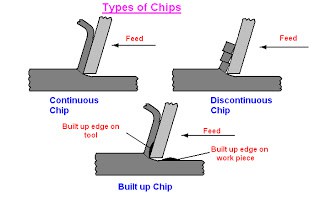
Continuous machining like turning of ductile metals, unlike brittle metals like grey cast iron, produce continuous chips, which leads to their handling and disposal problems. The problems become acute when ductile but strong metals like steels are machined at high cutting velocity for high MRR by flat rake face type carbide or ceramic inserts. The sharp edged hot continuous chip that comes out at very high speed
• becomes dangerous to the operator and the other people working in the vicinity
• may impair the finished surface by entangling with the rotating job
• creates difficulties in chip disposal.
Therefore it is essentially needed to break such continuous chips into small regular pieces for
• safety of the working people
• prevention of damage of the product
• easy collection and disposal of chips.
Chip breaking is done in proper way also for the additional purpose of improving machinability by reducing the chip-tool contact area, cutting forces and crater wear of the cutting tool.
Principles of chip-breaking
In respect of convenience and safety, closed coil type chips of short length and ‘coma’ shaped broken-to-half turn chips are ideal in machining of ductile metals and alloys at high speed.
The principles and methods of chip breaking are generally classified as follows :
• Self breaking
This is accomplished without using a separate chip-breaker either as an attachment or an additional geometrical modification of the tool.
•Forced chip breakingby additional tool geometrical features or devices.
Chip breakers are basically of two types :
• In-built type
In-built breakers are in the form of step or groove at the rake surface near the cutting edges of the tools. Such chip breakers are provided either
- After their manufacture –in case of HSS tools like drills, milling cutters, broaches etc and brazed type carbide inserts
- During their manufacture by powder metallurgical process– e.g., throw away type inserts of carbides, ceramics and cermets.
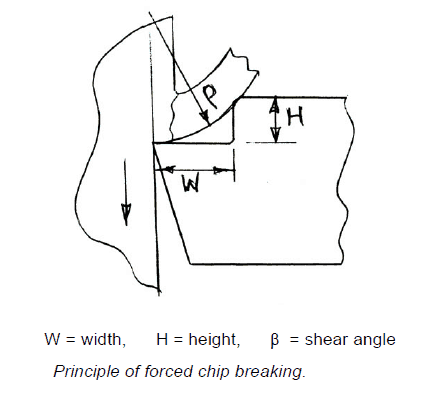
The basic principle of forced chip breaking is schematically shown in Fig. when the strain hardened and brittle running chip strikes the heel, the cantilever chip gets forcibly bent and then breaks.
- Clamped type chip-breaker
Clamped type chip breakers work basically in the principle of stepped type chip-breaker but have the provision of varying the width of the step and / or the angle of the heel.

Fig. schematically shows three such chip breakers of common use :
• With fixed distance and angle of the additional strip – effective only for a limited domain of parametric combination
•与可变宽度(W)只有-小多才多艺
Related posts:
 Chip breakers | Need , Purpose , Principles of chip-breaking
 Types of Chips in Metal Cutting – Basic of Chip Formation
 Basic Of Metal Cutting | Interview Question and Answers
 Theory Of Metal Cutting | Interview question and Answers
 Types Of Tool Wear Zones-Crater wear,Flank wear,Corner wear
 Supercharger | Types , Methods and Working Principles
 5 Lean Manufacturing Principles Engineers Should Know
 Suspension System | Components , Types , Working Principles