
目录
在加工过程中形成的芯片类型
由于在车床机或铣床上使用单点切削工具,有三种主要类型的切削芯片,其由于在车床机或铣床上使用单点切割工具而导致。
根据以下方式加工生产各种形状,尺寸,颜色等的不同类型的芯片
- 切割类型,即连续(转动,镗孔等)或间歇切割(铣削)。
- Work material (brittle or ductile etc.).
- Cutting tool geometry (rake, cutting angles etc.).
- Levels of the cutting velocity and feed (low, medium, or high).
- Cutting fluid (type of fluid and method of application).
无论切割条件如何,所产生的芯片可能属于以下三种类型之一。
1.不连续的筹码:
2.连续芯片。
3.连续芯片,带有堆积边缘(BUE)。
4.非均匀芯片
Types of chips in Metal Cutting:
来自单点工具的三种常见类型的芯片是。
1:不连续或分段芯片:
These types of chips are usually produced when cutting more brittle materials like grey cast iron, bronze, and hard brass. These materials lack the ductility necessary for appreciable plastic chips formation. The material ahead of the tool edge fails in a brittle fracture manner along the shear zone.
这产生了不连续芯片的小碎片。由于芯片分成小段,因此工具与芯片之间的摩擦减少,导致表面光洁度更好。这些芯片可以方便地收集,处理和处置。
不连续的芯片也在切割的过程中产生的more ductile materials under the following conditions:
(i) large chip thickness.
(ii)低切割速度。
(iii)使用切削液切割。
(iv) small rake angle of the tool.
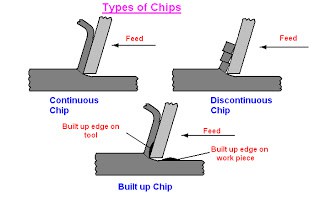
2:连续芯片:
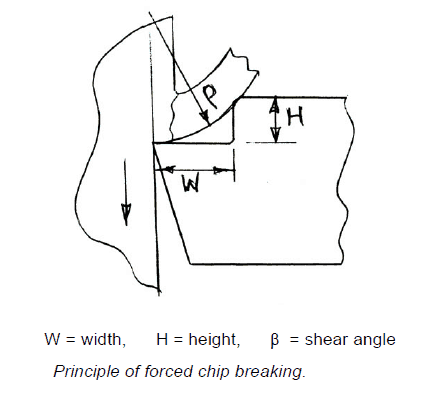
这些类型的芯片是在加工更多延性材料时产生的。由于具有延性材料的大型塑性变形,产生较长的连续芯片。这种类型的芯片是最期望的,因为它是稳定的切割,导致通常良好的表面光洁度。另一方面,这些芯片难以处理和处置。芯片线圈在螺旋(芯片卷曲)和围绕工作和工具周围的卷曲,并且在松开时可能会伤害操作员。而且,这种类型的芯片保持与刀具面的较长时段接触,导致更摩擦的热量。这些困难通常通过将工具面或机器安装在工具面上,“断路器断路器”,碎屑断路器的功能是减少芯片的1个曲率并因此破坏。
以下切割条件也有助于生产连续芯片:
- Small chip thickness.
- 高切割速度。
- Large rake angle of the cutting tool.
- Reducing the friction of the chip along the tool face, by: imparting high surface finish to the tool face, use of tool material with a low coefficient of friction, and use of good cutting fluid.
3: Continuous Chip with Built-up Edge:
- When machining ductile materials, conditions of high local temperature and extreme pressure in the cutting zone and also high friction in the tool-chip interface, may cause the work material to adhere or weld to the cutting edge of then tool forming the built-up edge.
- Successive layers of work material are then added to the built-up edge. When this edge becomes larger and unstable, it breaks up and part of it is carried up the face of the tool along with the chip while the remaining is left over the surface being machined, which contributes to the roughness of the surface.
- The built-up edge changes its size during the cutting operation. It first increases, then decreases, then again increases, etc. This cycle is a source of vibration and poor surface finish.
- Although the built-up edge protects the cutting edge of the tool, it changes the geometry of the cutting tool. Low cutting speed also contributes to the formation of the built-up edge.
- 增加切割速度,增加耙角,并且使用切削液有助于减少或消除内置边缘。
- Benefits of Continuous chip-在加工过程中产生连续芯片后,加工表面的质量比不连续的芯片产生更好(低表面粗糙度值)。
4.非均匀芯片(锯齿chip)
- The temperatures generated in the machining zone control the rate of tool wear, the practical cutting speed, and the MRR.
- It is important to understand the factors which influence the generation of heat, the flow of heat, and the temperature distribution in the tool and work material near the cutting edge.
• Temperature is developed in three types of zones as
剪切区域
2. Tool-chip interface
3.工具工作界面

状况在which above chips are generated –
| SR.没有。 | Types of chips | 状况 |
|---|---|---|
| 1. | Segmental or discontinuous chip | 用脆性材料加工生产,同时以低速度切割延展材料。 |
| 2. | 连续芯片 | Produced ductile material machining at normal cutting speeds with lower DOC. |
| 3. | 连续芯片with built-up edge | Cutting ductile materials with high-speed steel tools at low cutting speeds. |
| 4. | Non-homogeneous chip | 由于剪切平面处的较高温度,在介质切削速度下在刀具芯片界面处开发大应变。 |
Some Questions and Answers :
1. Explain with sketch chip formed during machining cast iron.
Discontinuous or segmental chips
Machining ofbrittle materials like cast iron生产这些类型的芯片。由于材料的延展性缺乏,产生小片段。工具和芯片之间的摩擦减少,导致表面光洁度更好。

2.用以下因素写入形成的芯片类型。
(i) High rake angle
(ii) High cutting speed
(iii)切割深度
(iv) Low cutting speed
(v)削减大深度
(vi)低耙角
Answer:
(i)高耙角:连续芯片
(ii) High cutting speed:连续芯片
(iii)切割深度:连续芯片
(iv) Low cutting speed:连续芯片与内置边缘
(v)削减大深度:连续芯片与内置边缘
(vi)低耙角:连续芯片与内置边缘
制造技术说明,文章
168博金宝
材料实力 - 笔记,文章,面试阙。&ans.
机械主体基本概念笔记,文章
Related posts:
 Chip Breakers- Needs ,Principles ,Types Of Chip Breakers
 金属切割理论|面试问题和答案
 Basic Of Metal Cutting | Interview Question and Answers
 Chip breakers | Need , Purpose , Principles of chip-breaking
 切割工具角度|切削工具角度的功能和效果
 Theory Of Metal Cutting – S K mondal Notes For GATE , IES
 单点切割工具 - 图,几何,命名法
 切割液及其应用的类型|切割液的选择