目录
Seminar On Just In Time Manufacturing ( JIT ) Full Report Download
抽象的
JIT is a management philosophy that strives to eliminate sources of manufacturing waste by producing the right part in the right place at the right time. The Waste results from any activity that adds cost without adding value, such as moving and storing. The idea of producing the necessary units in the necessary quantities at the necessary time is described by the short term Just-in-time.
The implementation of this management philosophy in industries like the automobile industry can bring about a see saw change in both quality & quantity since in a JIT system, underutilized (excess) capacity is used instead of buffer inventories to hedge against problems that may arise.
This seminar gives an over view of the正常通过考虑丰田生产系统详细考虑丰田生产系统。
介绍
JUST IN TIME (JIT) is a management philosophy that strives to eliminate sources of manufacturing waste by producing the right part in the right place at the right time. Waste results from any activity, which adds cost without adding value, such as moving and storing. JIT (also known as stockless production) should improve profits and return on investment by reducing inventory levels (increasing the inventory turnover rate), improving product quality, reducing production and delivery lead times, and reducing other costs (such as those associated with machine setup and equipment breakdown).
The idea of producing the necessary units in the necessary quantities at the necessary time is described by the short term Just-in-time. Just-in-time means, for example, that in the process of assembling the parts to build a car, the necessary kind of sub-assemblies of the preceding processes should arrive at the product line at the time needed in the necessary quantities. If Just-in-time is realized in the entire firm, then unnecessary inventories in the factory will be completely eliminated, making stores or warehouses unnecessary. The inventory carrying costs will be diminished, and the ratio of capital turnover will be increased.
吉特的元素
There are some
只是在时间制造业的非常重要的元素,这使得它成为一个
成功的哲学。
They are
- 攻击基本问题- 没有向产品添加价值的任何东西
- Devising systemsto identify problems.
- 争取简单性- 更简单的系统可能更易于理解,更容易manage and less likely to go wrong
- 面向产品的布局– produces less time spent moving of materials and parts.
- 来源质量控制- 每个工人都负责他或她的质量own output.
- Poka-yoke–“万无一失”的工具,方法,夹具等防止错误
- 预防性维护,总生产力维护- 确保机械和设备functions perfectly when it is required, and continually improving it.
- 消除浪费.
There
areseven types of waste:
1. Waste from overproduction.
2. Waste of waiting time.
3.运输废物。
4.加工废物。
5.库存浪费。
6. Unnecessary movement of people.
7. Waste from product defects.
好的家政服务–workplace cleanliness and organization.
Set-up time reduction–增加灵活性并允许较小的批次。理想的批量尺寸是
1item. Multi-process handling – a multi-skilled workforce has greater
生产率,灵活性和工作满意度。
平整/混合生产–to smooth the flow of products through the factory.
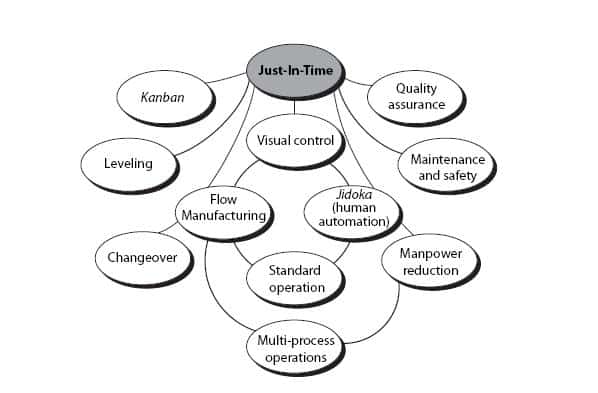
Kanbans–
简单的工具通过该过程提供产品和组件。
Jidoka(自主) -providing machines with the autonomous capability to use judgement,
so workers can do more useful things than standing watching them work.
Andon (trouble lights
) -发出问题以启动纠正措施。
Just-in-time production
The idea of producing the necessary units in the necessary quantities at the necessary time is described by the short term Just-in-time. Just-in-time means, for example, that in the process of assembling the parts to build a car, the necessary kind of sub-assemblies of the preceding processes should arrive at the product line at the time needed in the necessary quantities. If Just-in-time is realized in the entire firm, then unnecessary inventories in the factory will be completely eliminated, making stores or warehouses unnecessary. The inventory carrying costs will be diminished, and the ratio of capital turnover will be increased.
然而,为了仅对中央规划方法依赖于同时指示生产计划的中央规划方法,很难在像汽车这样的产品中的所有过程中实现立即性,这包括成千上万的零件。因此,在丰田系统中,有必要相反地看生产流量;换句话说,某种过程的人们转到前面的过程,以在必要的时间内以必要的数量撤销必要的单位。然后,前面的过程必须做的是只生产足够数量的单位来替换被撤回的单位。
因此,丰田在制造业中的口号将是尽可能小的批量生产,按照市场需求的最低成本。如果我们看待像丰田这样的汽车行业进入装配线的部件,我们发现定制在最终阶段最大。例如,客户会选择颜色座位等。这会发生在大会上。然而,在聚合阶段,特定模型将具有特定的发动机,传输等。许多常见部分进入不同的模型。最后,相同的钢铁铁进入不同的部位。示意图是如下。
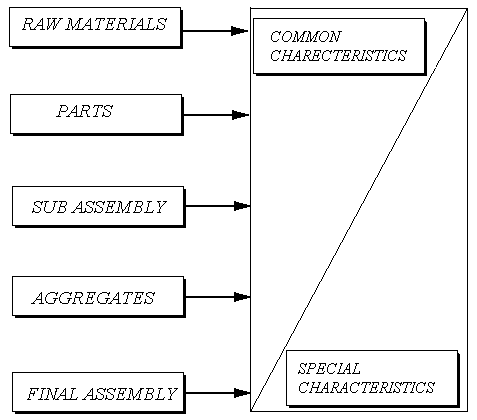
Planning system for materials can be based on the forecast
作为最终组装的规划系统必须基于接受的订单
当一个人从原材料移动到成品时,存在过渡
planning.
References:
The Machine that changed the World – Womack, Jones and Roos
Toyota Production System – Yasuhiro Monden
丰田生产系统研究 - Shigeo Shingo
Download
最好的低成本机械项目188金宝搏怎么样
Production Engineering Notes , article , Interview Que and Ans
Product Ideas , Innovative Machine Ideas Projects
制造技术说明,文章
New Mechanical Projects 2020 ( All Projects Post Index List )
[